
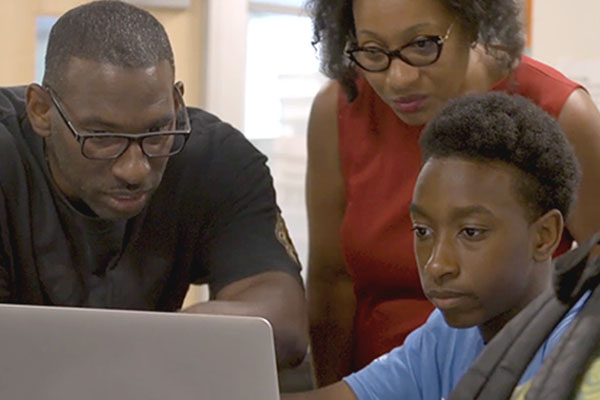
A young scientist at the Penn State Genes and Genealogy summer camp shows his parents what he learned in class about their family’s genetic ancestry.
Awards and Collaborations
Awards and Collaborations
For most of my career, I’ve worked as an independent artist and designer making interactive media, animations and illustration for commercial clients. My business was humming along and then in 2001, I got curious about the audacious achievement of the draft sequence of the human genome. I started to pay attention.
To draw and write about the science of the genome, I had to understand the basics. But new developments were difficult to grasp and I had forgotten much of my college intro-biology class.
Determined to be genome-literate, I bought books, subscribed to journals, but the most intense learning came from attending scientific conferences. Entering rooms full of people speaking a language I was still acquiring was intimidating. But a few took me seriously and answered my questions—none more generously than Dr. Perry Hackett.
Perry was a geneticist at the University of Minnesota. He became my mentor. Seeing the value of art and story to communicate research, he encouraged my work and provided introductions to other scientific leaders.
My first body of work, the DNA Portraits, caught the attention of University of Minnesota anthropologist Dr. Irma McClaurin. She championed my proposal for portraits of five leaders from a North Minneapolis community leading to the commission for the DNA Portrait Exhibit.
Cold Spring Harbor Laboratory. Dr. Hackett encouraged me to go to meetings at Cold Spring Harbor Laboratory (CSHL) on Long Island in New York. I jumped at the chance when Dr. David Stewart, executive director of meetings and courses, invited me to attend.
My first CSHL meeting was the symposium “Evolution: The Molecular Landscape” during the Year of Darwin, 2009. I’ve been showing my work at the annual Biology of Genomes meeting ever since.
Visiting the lovely CSHL campus has led to other opportunities. Ludmila Pollock, Executive Director of the CSHL Library & Archives, encouraged me to apply for her artist-in-residence program. I got the grant, lived on campus, interviewed plant biologists, and published “Decoding Plant Genomes” about their research.
After publication, CSHL scientist Jack Satterlee, greenhouse manager Blaine Fitzgerald, and I co-developed a hands-on plant genetic engineering course based on my book and their research. I made a companion workbook with classroom activities especially for the course. Designed for 10-13-year-olds, the course was sold out and was a big hit at the DNA Learning Center.
Fulbright Scholar to Israel. For my Fulbright Senior Scholar project, I collaborated with Dr. Dan Mishmar, evolutionary geneticist at Ben-Gurion University of the Negev, Israel. Over four months of weekly lab meetings and department lectures, I wrote the script, recorded narration, and designed an animated video about his mitochondrial research. Titled “Gene Cross-Talk for Co-evolution,” you can watch the video here.
Bioinformatic scientists. Working with the Bioinformatics scientists at the National Marrow Donor Program (NMDP) was an advanced course on the HLA immune system. I made two videos explaining their research: Genetic Ancestry for a Better Match and Meet the Bioinformatics Group.
National Evolutionary Synthesis Center (NESCent). One of five National Science Foundation (NSF) research centers, NESCent was a think tank for innovative, cross-disciplinary, evolutionary research at Duke University. I was granted a six-month residency for my proposal to design new media about genomics and human evolution.
While working on my own project, I was invited to join a working group led by Dr. Nina Jablonski and Dr. Henry Louis Gates Jr. Our proposal to develop curricula for middle school students connecting their genetic ancestry with family history received funding — from the NSF and Robert Wood Johnson Foundation.
The grants allowed us to develop two programs: the Genetics and Genealogy curricula for undergraduates at Spelman College and the Finding Your Roots summer camp for teens at Penn State University.
The programs promoted science education through an interdisciplinary approach, using genealogy to engage students in biology concepts through exploring their personal DNA. I designed interactive media for the programs: a digital book for Spelman and a visualization tool for Penn State.
The positive response to the programs led to the development of The Seedlings, a documentary produced by Dr. Jablonski and Dr. Gates.
Skin We Are In, a book about the evolution of human skin color, is another collaboration with Nina Jablonski. It celebrates the glorious human rainbow as an illustrated story with the science written by Nina, story by Sindiwe Magona, and artwork by me.
The book was published by South African publisher David Philip Books in eleven African languages. It’s available from my online store and from Amazon.