

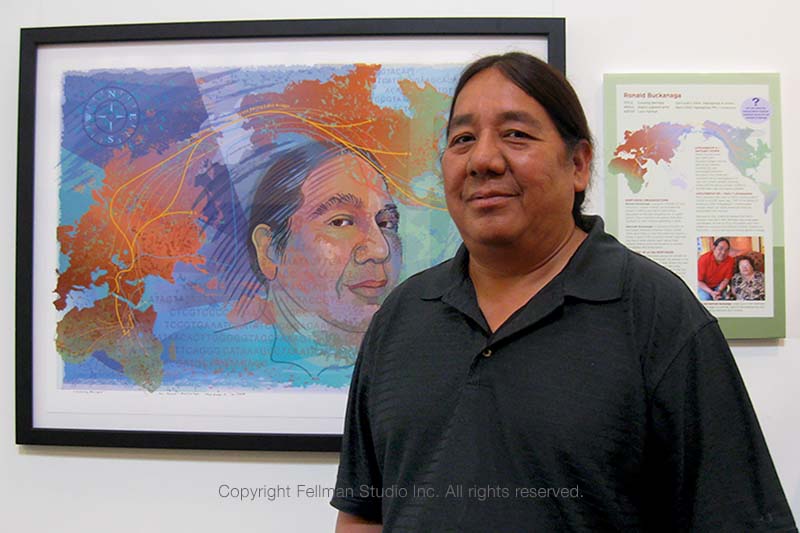
This DNA portrait, titled “Crossing Beringia,” shows the migration paths of Ron Buckanaga, a Native American from Minnesota. All of my DNA Portraits include a storyboard that explains the scientific data in the artwork. That’s Ron in front of his portrait at the opening of the exhibit.
Genetic Ancestry Portraits
Genetic Ancestry Portraits
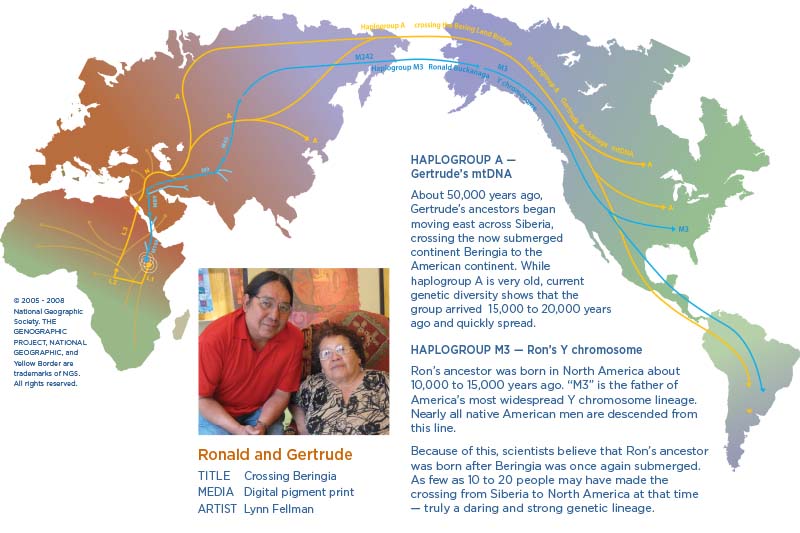
A DNA portrait traces the ancient migration paths of your ancestors. “Crossing Beringia” is a portrait of a Native American man (Ron) from the Ojibwe Nation in Minnesota.
Follow the paths of his maternal (yellow) and paternal (blue) ancestors as they leave Africa, heading north to Siberia and across the now-submerged land bridge Beringia to the Americas — a journey made over thousands years.
The University of Minnesota commissioned this portrait and four others (three shown below) for an exhibit at their Urban Research and Outreach-Engagement Center (UROC).
I built the exhibit on a body of work produced over five years—DNA portraits of more than 24 people showing their genetic data (migration paths) on a map with a written interpretation of the science. If you’re curious about my process and artistic vision for the exhibit, please read Making the DNA Portraits.
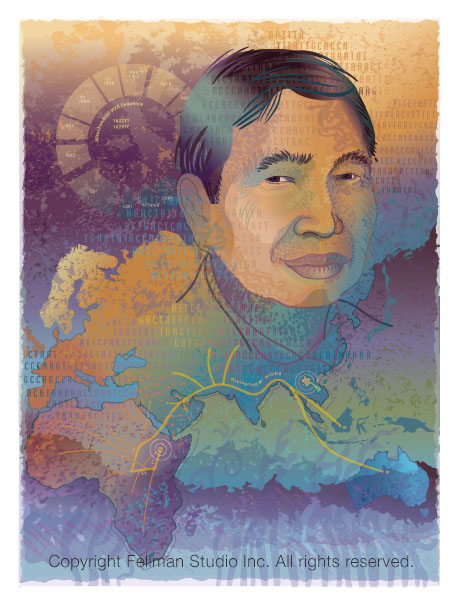
First Wave
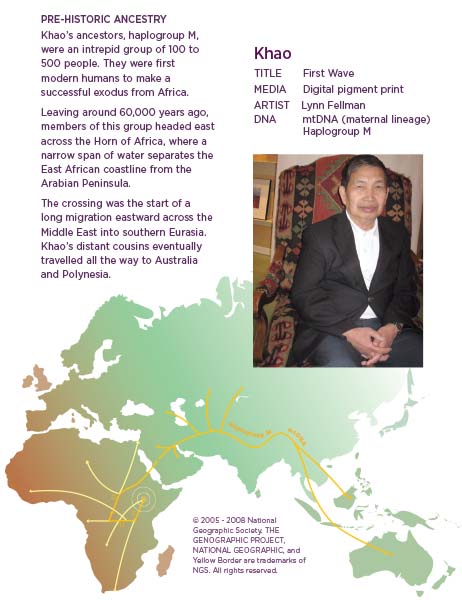
Khao is an American originally from Laos. His portrait, “First Wave,” shows his maternal migration path, haplogroup M. They may have been the first modern humans to depart from Africa successfully. Members of his group headed east across the narrow span of water that separates East Africa from the Arabian Peninsula.
It started a long migration eastward, across the Middle East to Southern Eurasia — close to Khao’s birth home in Laos. You can see that the lineage branches with some of his ancestors continuing to settle in Australia and Polynesia.

Spiral Journey
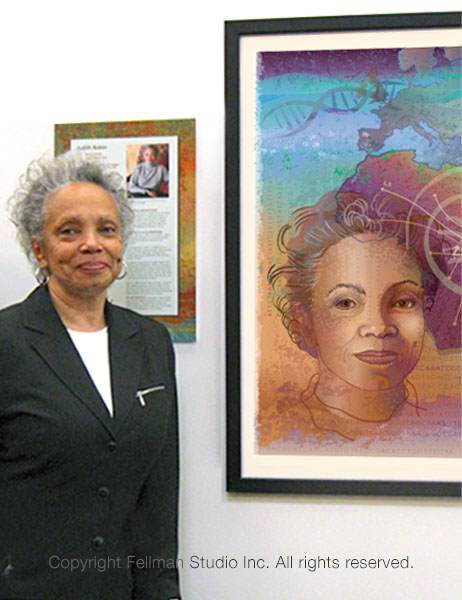
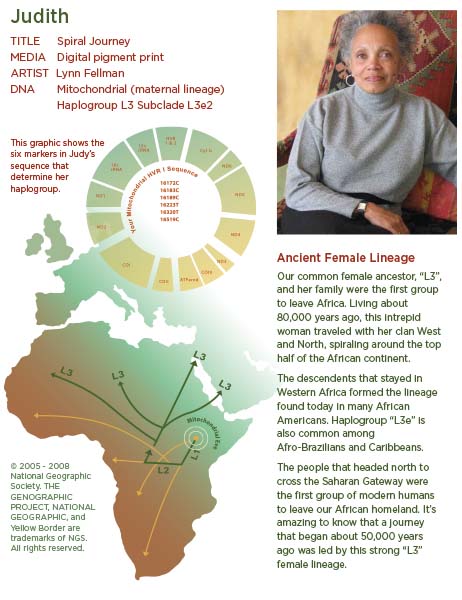
“Spiral Journey” is a portrait of Judy, an African American woman. It traces the paths of the L3 group, a lineage that arose in Africa about 80,000 years ago. They were a group of modern humans leading the out-of-Africa migrations.
Judy’s ancestors were members of a group that decided to remain in Africa — traveling west and north, spiraling around the continent’s top half. Descendants in Western Africa formed the lineage found today in many African Americans — often due to the transatlantic slave trade. Judy’s “L3e” haplogroup is also common among Afro-Brazilians and Caribbeans.



Deep Waters
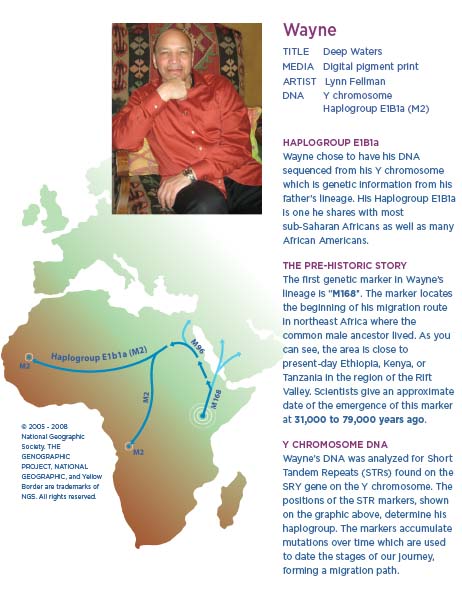
Wayne, an African American man, chose to have his DNA sequenced from his Y chromosome. “Deep Waters” shows his paternal Haplogroup, E1B1a (M2), is shared with most sub-Saharan Africans and many African American men.
The first genetic marker in Wayne’s lineage is “M168”. The marker locates the beginning of the migration route close to present-day Ethiopia, Kenya, or Tanzania in the Rift Valley region. Scientists estimate the emergence of this marker to be approximately 31,000 to 79,000 years ago.
Genetic Ancestry and Family History Portrait
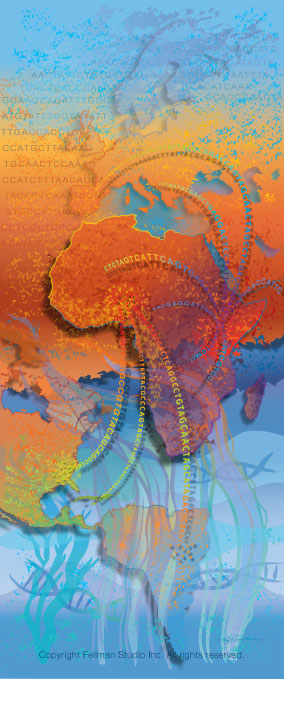
This portrait of Dr. Charmaine Royal is a big-picture view of ancient migrations out of Africa combined with Charmaine’s knowledge of her family history.
I worked closely with Charmaine to capture her story. She holds the finished work close to her heart — and her scientific research. The artwork is central to who she is: director of the Center on Genomics, Race, Identity, and Difference at Duke University, and a Professor of African and African American Studies, Biology, Global Health, and Family Medicine.
Charmaine’s DNA Portrait was printed on canvas with the top wrapped on a wooden dowel and displayed like a tapestry in her office at Duke. Please read Making the DNA Portraits to learn more about my process and artistic vision for the artwork.