
Superpowers are real in synesthesia, a genetic and neurological condition giving the ability to process several senses together.
Synesthesia is a Superpower
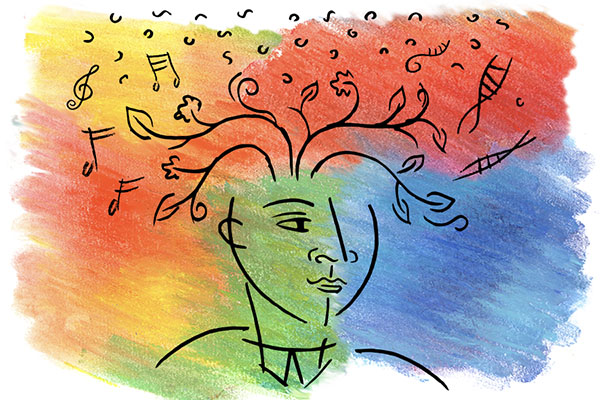
Synesthesia is a superpower.
If you don’t believe superpowers are real, consider this: what if you could taste words or see colors when hearing sounds?
Some people do have unusual abilities. They carry genetic variants for a neurological condition called synesthesia — highly connected, “cross-wired” brains where sensory regions mix and mingle.
A Science article on synesthesia describes this mingling of the senses, which may result from hyperconnected neurons in the brain for some lucky humans.
Alas, I don’t have it, so I gave the superpower to the character in my books. She uses her “Listening Eyes” and “Observing Fingers” as extra-sensory powers to understand genomics.
Check my sources! Scroll to the bottom for the list. They include critical information about the scientific expertise of the authors, their academic affiliation and location.
Is there a gene for synesthesia? Not one, but many genes usually work together to shape a trait, and synesthesia is no exception. Scientists asked a family with the sound-color version of synesthesia to be part of a study to find the genes.
What did they find? They sequenced their DNA and compared the results to a family member without the superpower. They found thirty-seven genes with variants that “relate in some way to the development of connections between neurons.”
Do artists have it? Synesthesia appears to be more common among people with extraordinary creative abilities. Billie Eilish’s compositions are influenced by her sensory abilities. Paul McCartney sees the days of the week as distinct colors. Sarah Kraning is a synesthete and made a TEDx talk about her experience.
A psychology study tested the relationship between different types of synesthesia and their involvement in art, creative, and visual abilities. The authors of the paper, “Creativity and involvement in art in different types of synesthesia,” concluded:
Results show a higher prevalence of artists among synesthetes, especially sound‐color. They scored higher in visual‐spatial abilities. Synesthetes were overall significantly more likely to be involved in a creative profession.
Evolution likes variation. Synesthesia doesn’t flare up once and disappear. It’s a heritable trait, passed down like eye color or a good ear for pitch. A trait that persists across generations has been conserved.
In evolutionary terms, conserved means natural selection kept it around instead of quietly deleting it. Is there something about a cross-wired brain that earns its keep?
Researchers at the University of California, San Diego reviewed the current research in a paper titled, “Survival of the Synesthesia Gene: Why Do People Hear Colors and Taste Words.” Some of their conclusions:
The genes that cause synesthesia to happen in specific sensory regions might encourage increased connectivity across higher-level, conceptual brain areas. This cross-wiring is hypothesized to provide a major boost to creativity and problem-solving, making synesthetes significantly more prevalent among artists, poets, and innovators.
In evolutionary terms, conserved means natural selection hangs onto the genetic variation. Scientists may not call them superpowers, but heightened-mixed-mingled sensory abilities are real and powerful.
I’m entranced by the curious mechanisms of evolution. “Synesthesia — Mutation Rhapsody” is the first in a series about the most fascinating aspects of evolutionary biology and genomics. The video below shows the work and you can buy a limited edition print of it from my online store.
Sources
Have you read a scientific paper? They’re not so tough. Start with the abstract and skip to the conclusion. It gives you the shape of the research — what they did, what they found, why it matters.
— “Synesthesia’s mysterious ‘mingling of the senses’ may result from hyperconnected neurons” Review article by Michael Price, deputy news editor for Science. March 2018. Open access. Link.
— “Rare variants in axonogenesis genes connect three families with sound–color synesthesia.” Language and Genetics Department, Max Planck Institute for Psycholinguistics, 6500 AH Nijmegen, The Netherlands. PNAS. March 2018. Open access. Link.
— “Creativity and involvement in art in different types of synesthesia.” Institute of Psychology, University of Bern, Switzerland. NIH PubMed Central. November 2018. Open Access. Link.
— “Survival of the Synesthesia Gene: Why Do People Hear Colors and Taste Words?” Department of Psychology, University of California, San Diego, La Jolla, California. NIH PubMed Central. November 2011. Open Access. Link.